Table of Contents
ToggleThe debate over dishwashers versus hand washing has shifted dramatically in recent years, driven by real data on water usage, energy consumption, and household budgets. For decades, the conventional wisdom suggested that hand washing was more economical and environmentally friendly. But modern dishwashers tell a different story. With tighter regulations on water efficiency and smarter cycles, today’s machines challenge that assumption. Homeowners who are considering their kitchen setup, or contemplating whether to replace an older dishwasher, often wonder: does a dishwasher actually save water? Is it worth the upfront investment? This article cuts through the marketing claims and Pinterest inspiration to examine what the numbers actually show.
Key Takeaways
- Modern ENERGY STAR-certified dishwashers use 3–5 gallons of water per cycle, compared to 25–40 gallons for hand washing, making dishwasher water efficiency a proven advantage for most households.
- Over 10 years, utility savings from switching to a dishwasher (typically $1,500–$3,000) often exceed or match the initial purchase price of $500–$2,000, delivering strong long-term financial returns.
- A dishwasher cuts active dishwashing time from roughly 2.5 hours per week to just 2 minutes of loading, freeing up over 130 hours annually for busy households.
- Environmental impact favors dishwashers within 2–3 years of use, as water and energy savings offset manufacturing carbon costs, especially in regions with renewable energy.
- For maximum dishwasher efficiency, always run full loads, load properly with plates on the bottom rack and glasses on top, and use ENERGY STAR-certified models with adjustable cycles.
- Hand washing works best for delicate items, cast iron, non-stick cookware, and wooden utensils, while a hybrid approach of dishwasher for everyday dishes and hand washing for special items captures most efficiency gains.
Energy and Water Consumption: The Real Numbers
How Modern Dishwashers Compare to Hand Washing
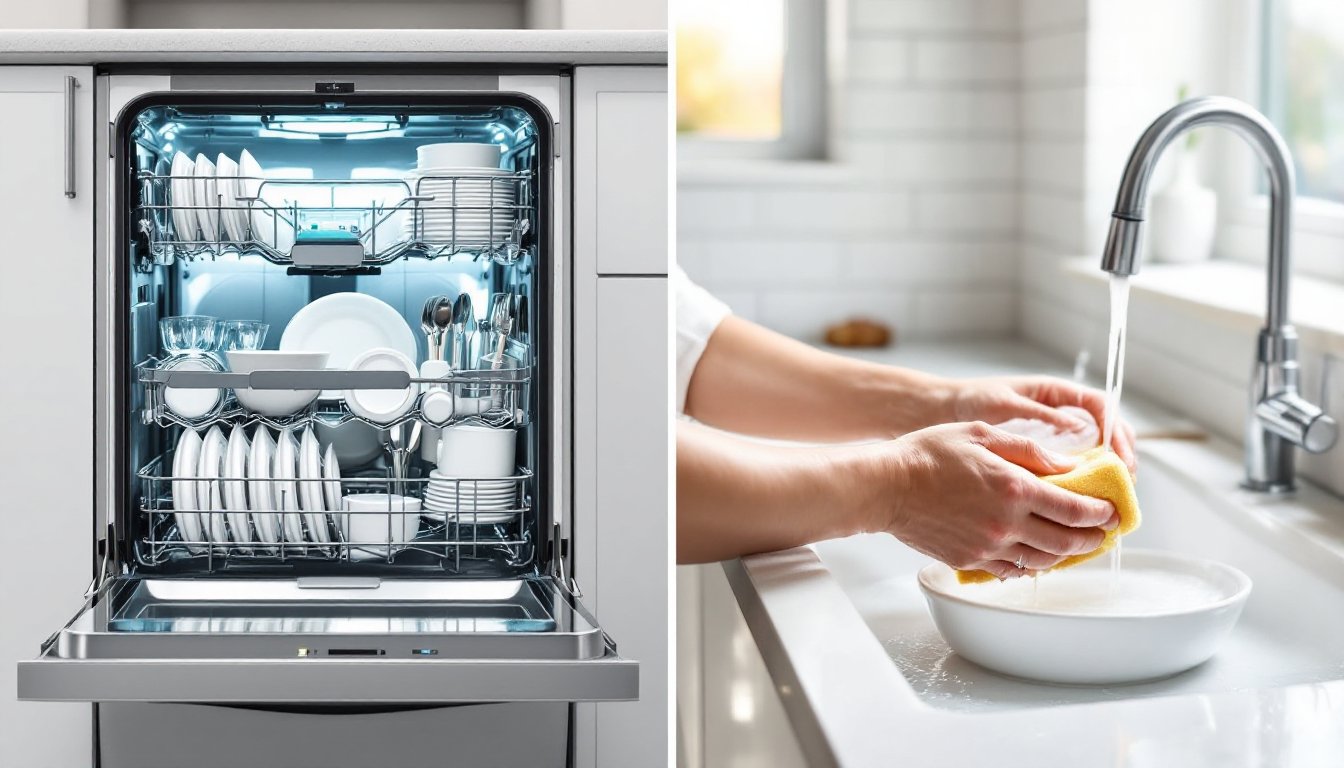
Here’s the straightforward answer: modern dishwashers use significantly less water than hand washing. A full load in an ENERGY STAR-certified dishwasher typically uses between 3 and 5 gallons of water per cycle. Hand washing a full sink of dishes, letting the tap run while scrubbing, often uses 25 to 40 gallons or more, depending on your faucet flow rate and technique.
The difference becomes obvious when you do the math. A household that runs a full dishwasher four times per week uses roughly 624 to 1,040 gallons monthly. That same household hand washing dishes daily? Closer to 7,500 to 12,000 gallons per month, even with conservative estimates. The EPA has documented this gap consistently, and it’s one reason ENERGY STAR standards now mandate dishwasher efficiency.
Why the dramatic difference? Dishwashers spray water strategically, with jets hitting dishes from multiple angles, maximizing contact while minimizing waste. Hand washing typically involves either running water continuously or filling a basin multiple times for rinse cycles. Most people also use hotter water by hand, which requires more energy to heat. Modern machines regulate both temperature and water flow with precision that hand washing simply can’t match.
One important caveat: these savings assume you’re running a full load. A dishwasher with only a few items uses nearly as much water as a full cycle. According to resources on dishwasher loading tips, ensuring your machine is fully loaded before running it maximizes the return on that water investment. Running a half-empty dishwasher defeats the economic and environmental advantage.
Cost Comparison Over Time
Initial Investment vs Long-Term Savings
A quality dishwasher costs between $500 and $2,000 depending on features and capacity. That’s a real expense, and it’s valid to question whether the water savings justify the purchase. But spread that cost over the appliance’s typical 10-year lifespan, and the math shifts.
The average American household spends roughly $300 to $500 per year on water and sewer costs. Moving from hand washing to dishwasher use can reduce that bill by 30 to 50 percent, saving $90 to $250 annually in water costs alone. Factor in the energy savings, dishwashers heat only the water they use, while hand washing often means running hot water for extended periods, and annual utility savings often exceed $150 to $300 per household.
Over ten years, that’s $1,500 to $3,000 in utility savings. For many households, those savings cover or exceed the initial purchase price, making the dishwasher essentially free. Even in regions with low water costs, the financial case remains strong once you include energy savings. Homes in drier climates where water is metered and priced higher see the payback period shrink to five years or fewer.
One variable often overlooked: repair costs. Dishwashers can need maintenance, typically running $200 to $500 for significant repairs. Hand washing involves no equipment, so there’s no maintenance expense. But, newer models are increasingly reliable, and many dishwashers come with extended warranty options that reduce risk.
Time and Convenience Factors
Here’s where the math becomes personal. Hand washing a full load of dishes, plates, bowls, glasses, silverware, pots, and pans, takes the average person 20 to 30 minutes. Running a dishwasher takes about two minutes of loading time and zero active work for 2 to 4 hours while the cycle runs (most machines finish between 90 and 240 minutes depending on the cycle selected).
Over a week, if a household hand washes once daily, that’s roughly 2.5 hours of active labor. Over a year, that’s more than 130 hours spent scrubbing, rinsing, and drying. For busy households, two working parents, school-age children with activities, side projects, that time adds up fast. Many people in this category will tell you that the dishwasher isn’t just convenient: it’s a genuine quality-of-life improvement.
The counterpoint is worth acknowledging: some people prefer hand washing. They like the meditative rhythm, the control over how dishes are cleaned, or the absence of mechanical sounds. That’s legitimate. But if you’re evaluating the choice purely on convenience, the dishwasher wins decisively. And for households where water scarcity is a concern or environmental footprint matters, the convenience becomes a bonus on top of genuine utility savings.
Environmental Impact and Sustainability
Water consumption is the headline, but the full environmental picture is more nuanced. A dishwasher uses less water and less energy than hand washing, which improves carbon footprint as well. But, manufacturing a dishwasher requires materials and energy upfront, steel, copper wiring, electronic components. Does running one for ten years offset that embedded carbon cost?
Lifecycle analyses suggest yes. Most dishwashers break even on their manufacturing impact within the first two to three years of use, given typical household usage. After that point, the water and energy savings represent genuine environmental benefit. Regions powered primarily by renewable energy see even faster payback on embedded carbon.
There’s also the question of detergent. Dishwashers use less detergent per dish than hand washing, and modern tablets and powders are formulated to break down more readily in aquatic environments. But, using too much detergent in a dishwasher is still wasteful, so following the machine’s guidance matters.
For households prioritizing sustainability, another consideration arises: does the household have access to a water-efficient faucet and hand-washing practices? Someone using a low-flow faucet and filling a basin for hand washing comes closer to matching a dishwasher’s efficiency than someone running water continuously. But most households don’t optimize hand washing this way, so the dishwasher typically wins on environmental grounds. Research from Real Simple and similar sources emphasizes that convenience and efficiency often align in modern appliances.
Dish Care and Cleaning Effectiveness
There’s a persistent myth that hand washing cleans better. In reality, dishwashers clean as well or better than hand washing, especially for food debris and bacteria removal. The high-temperature water (140°F to 160°F) and targeted spray action remove dried-on food more effectively than hand scrubbing for most dishes. But, dishwashers do have limitations.
Cast iron, certain non-stick cookware, fine china, and stemware often fare better by hand. The agitation and heat in a dishwasher can damage these items over time. Wooden spoons and cutting boards should go by hand too. And dishwashers don’t work well with burnt-on food that requires soaking and elbow grease.
Most households run a mixed strategy: dishwasher for everyday plates, bowls, and glasses: hand washing for pots, pans, delicate items, and anything requiring special care. That hybrid approach captures most of the efficiency gains while protecting items that warrant gentler treatment.
Loading technique matters significantly. Overcrowding prevents water from reaching every surface, and blocking spray arms reduces effectiveness. Rinsing heavily soiled items first, not a full hand wash, just a quick rinse, helps the machine work more effectively. Placement matters too: plates and bowls on the bottom rack, glasses and cups on the top, silverware in the basket with handles pointing down for better cleaning and drying access.
Making the Decision for Your Household
Choosing between a dishwasher and hand washing depends on several factors specific to your situation. If water costs are high in your region, you’re on a well with limited capacity, or environmental impact weighs heavily in your decisions, a modern dishwasher makes financial and practical sense. If your household generates enough dishes to fill a machine at least three to four times weekly, the economics clearly favor the dishwasher.
If you live alone or a two-person household that produces minimal dishes, hand washing using an efficient technique (basin method, low-flow aerator) might make more sense both financially and environmentally. Running a dishwasher with half a load defeats the purpose entirely.
For those upgrading an older dishwasher, replacement is almost always justified. Machines from the 1990s and early 2000s used 25 to 40 gallons per cycle, not much better than aggressive hand washing. Modern ENERGY STAR models use less than half that water, making an older machine a significant drain on both budget and resources.
When shopping, look for ENERGY STAR certification and a machine with adjustable cycles. Models with soil sensors and quick-wash options give flexibility for partial loads or lightly soiled dishes, maximizing efficiency for varied household needs. And remember: a dishwasher’s true efficiency depends entirely on how you use it. Full loads, appropriate detergent, and proper loading technique transform it from an appliance into a genuine utility investment.